
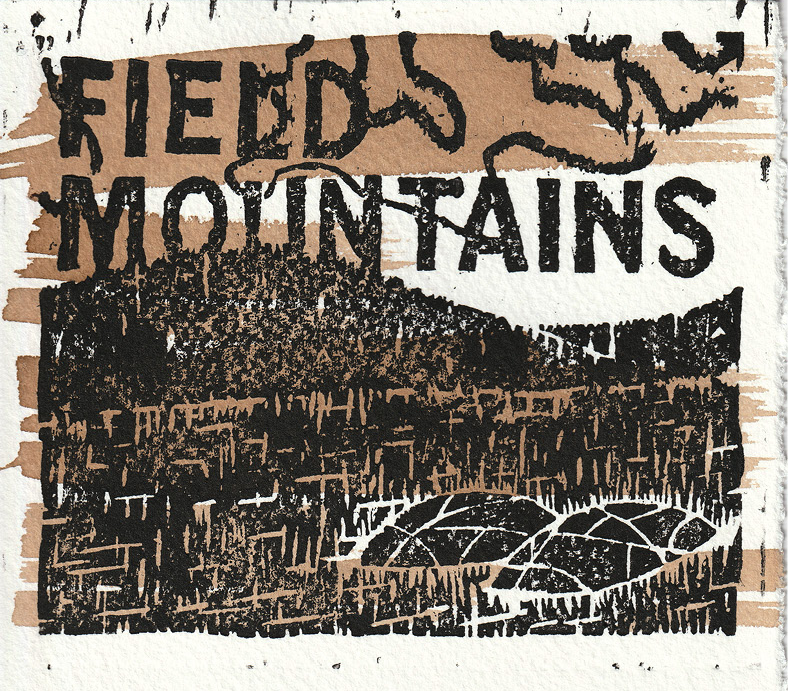
Field Mountains
Opening Event
At the Turquoise Barn
Sunday, February 1, 2026, 5-7 PM
(rain date 2/8/26)
ART + POETRY + SOUND PERFORMANCE
Alana Siegel will read poetry
Brian Crabtree will perform live sound / music
There will be a fire ceremony at 6 pm.
The Turquoise Barn
8015 Rt 18 (River Road), Bloomville, NY
Field Mountains is a public sculpture by local artist John Atwood in a field on Route 18 in Bloomville, NY.
The work consists of two mountain-like forms that speak to the surrounding mountains.
The sculpture is visible from cars passing on the road.
Located in a field at The Turquoise Barn, a well known art and event space, the project originated when Michael Milton, an artist and the co-founder of the organization, saw a woven grass sculpture I exhibited in 2024. The ephemeral, natural material and woven qualities fit an idea Michael has had for years. He has wanted to coordinate an evolving series of sculptures in fields on Rt 18, made from biodegradable materials so that each piece would last for only a few years. He invited me to make the first work.
Please explore this page to find out more about the work. And come to see it in person!
—John Atwood
INSPIRATION
Island and Mountain Sculpture
Field Mountains is inspired by previous sculptures I have made and concepts that are important to me.
Art making is a long process of being struck by abstract thoughts, acknowledging them, exploring them and combining them. I will describe some thoughts behind my island and mountain sculptures and other ideas that relate specifically to Field Mountains.
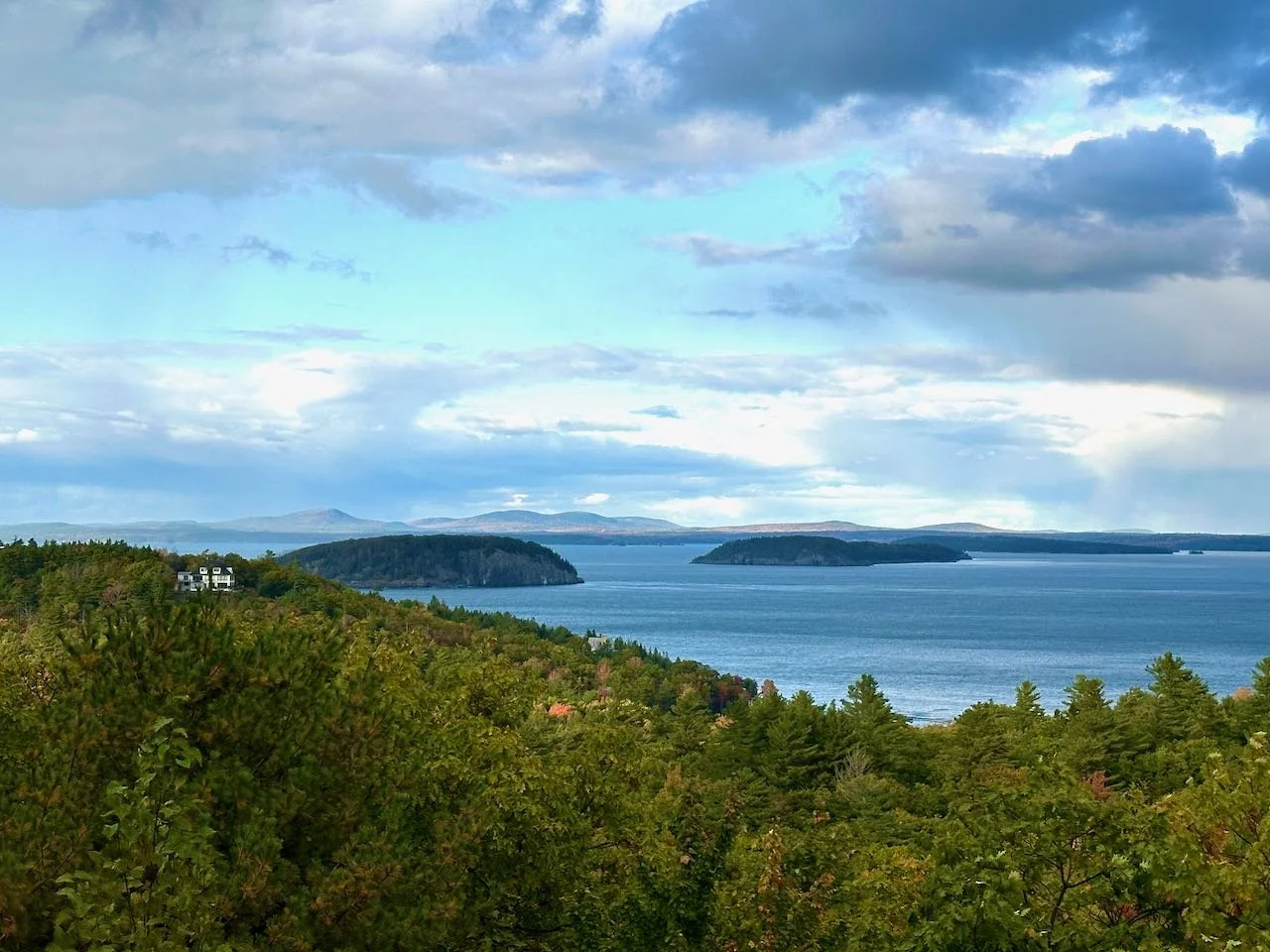
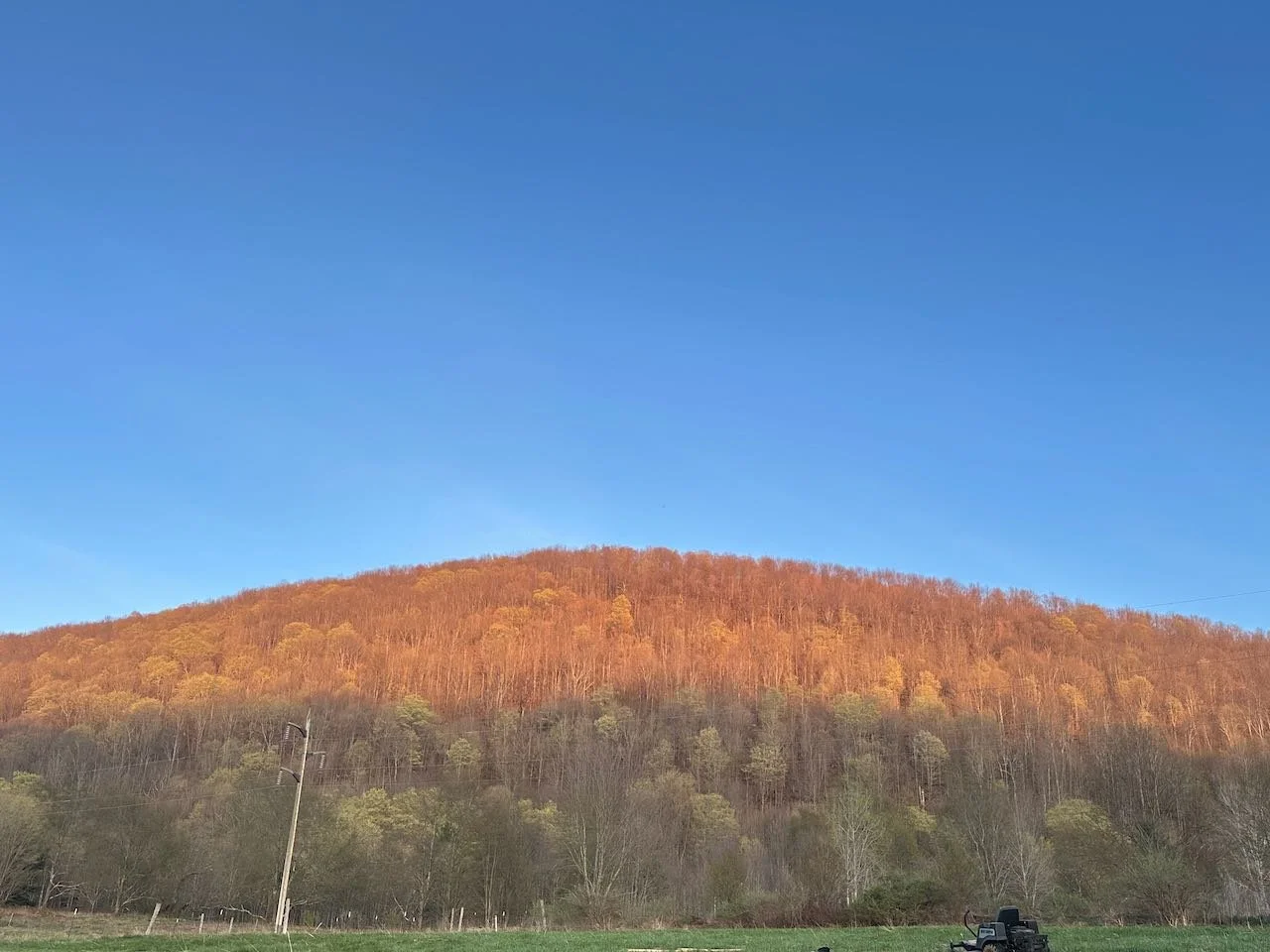
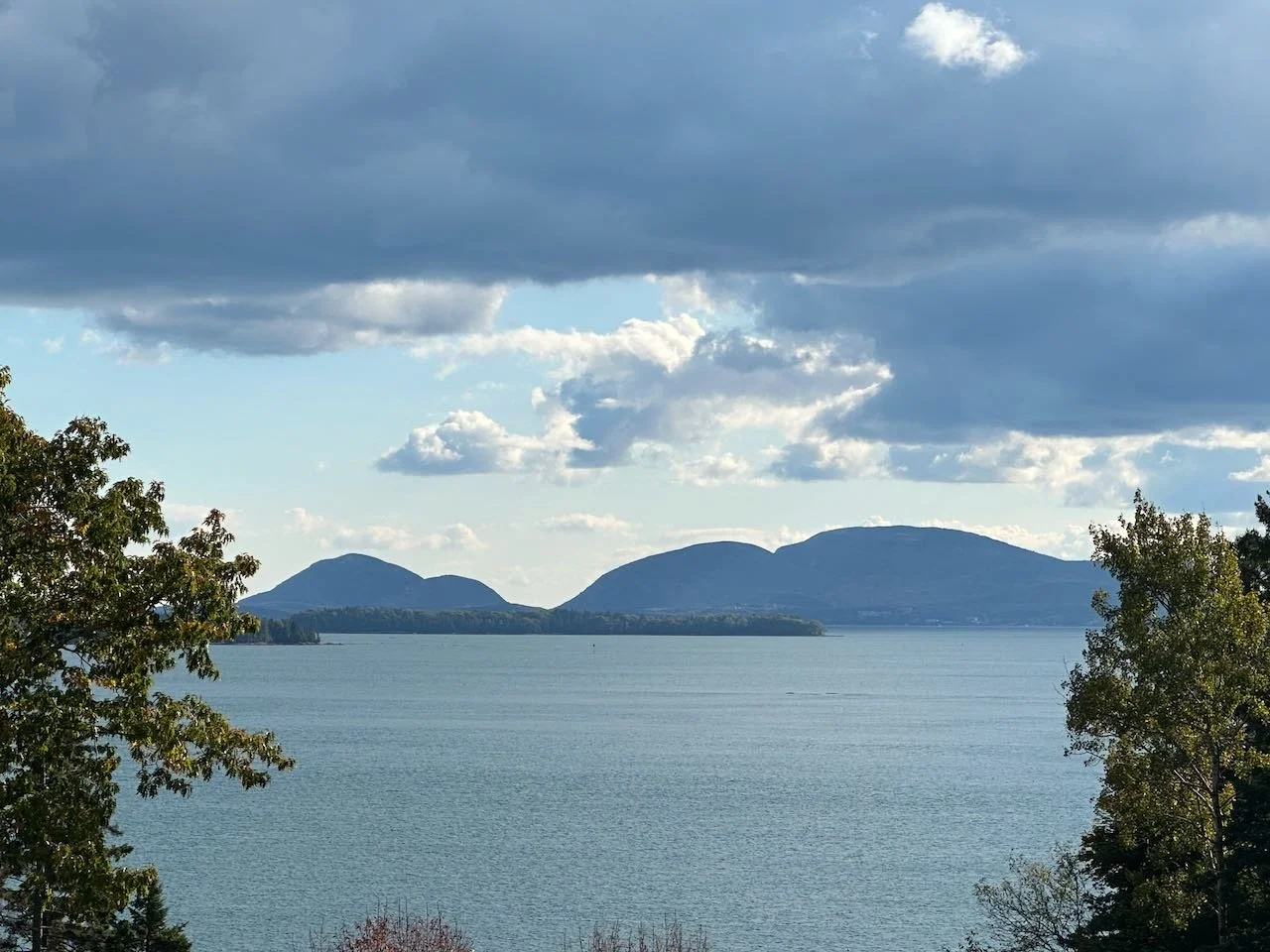
When I was invited to make this outdoor sculpture, I knew that I wanted to make a giant version of small sculptures inspired by the silhouettes of islands I have seen throughout my life on the coast of Maine. The organic, elegant shapes always remind me of animals, or the outline of human bodies. Islands on the horizon literally feel alive to me. I used to fish for cod next to an island called The White Bull. I see the mountains in Delaware County the same way. Driving through the valleys, the long, graceful lines and intriguing shapes make the forms change constantly as one moves by them. They undulate like living beings. I see an animal’s hip or back, bodies lying together, or long legs. When mountains or islands overlap one another they are like giant bodies close to one another. It is similar to seeing star constellations and thinking about how past cultures saw zodiac signs and the gods, massive above them, present each night. It is magical to me to experience the landscape take on mythical, living form, even if just conceptually.
You may see my first island sculpture in a case at luck dragon, the art supply store in Delhi. Among the additional sculptures in the series, some have a different number and orientation of island, or body forms, and they are made from a variety of materials. The contrast in the scale of the six inch and the sixty foot sculpture is fascinating to me. I am looking to create spiritual energy and for me both scales are valid and potent. The small one is ritualistic, the spirit of the idea captured in a hand- and body-sized form that suggests one might need to have it with you. It’s like lightening in a bottle. The subtlety of the shapes and the smoothness, and the feeling in your hand communicates so much. The large one is ritualistic in a wild, grand way, where the forms actually stand up and speak to the neighboring mountains.
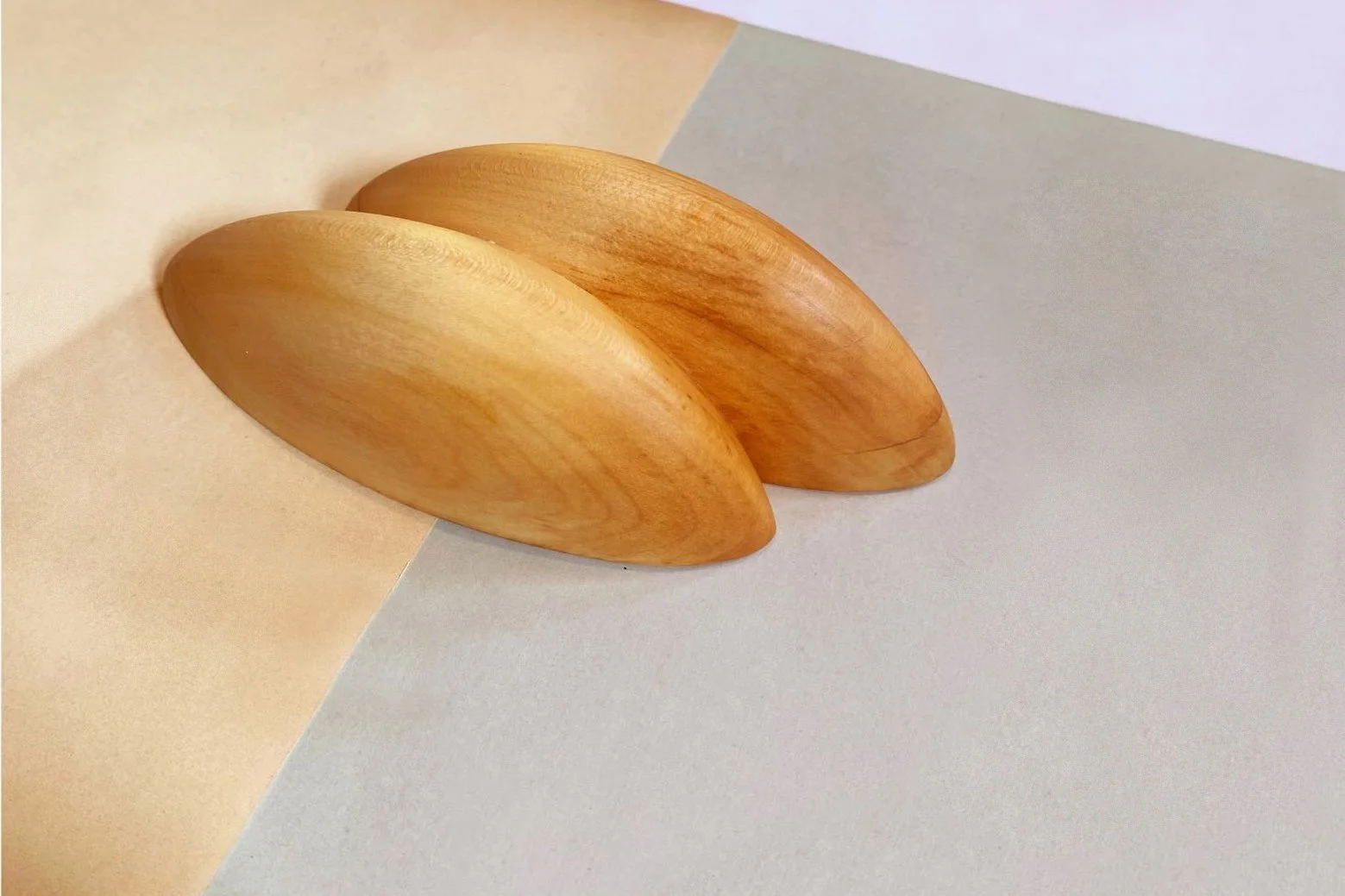
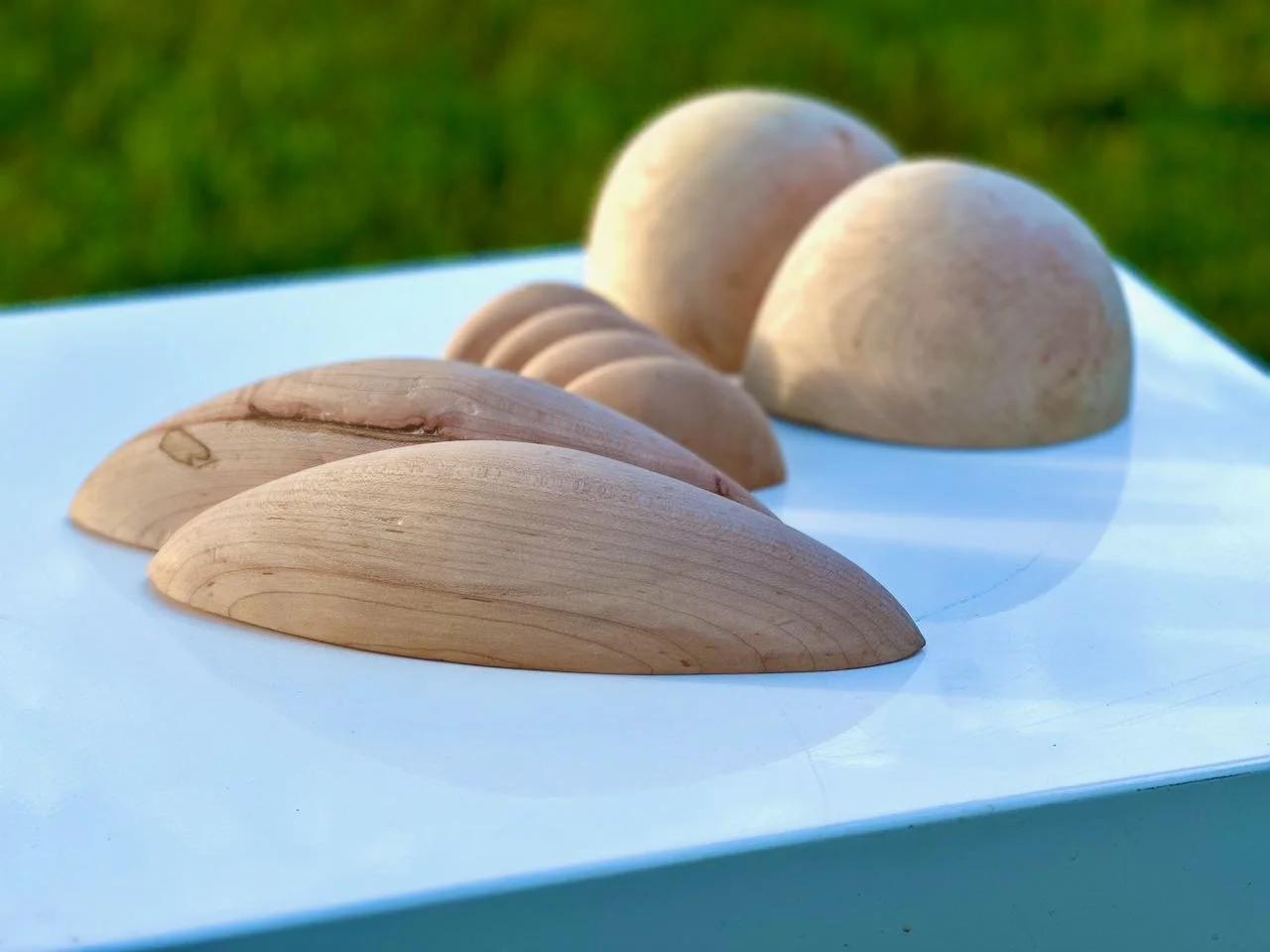
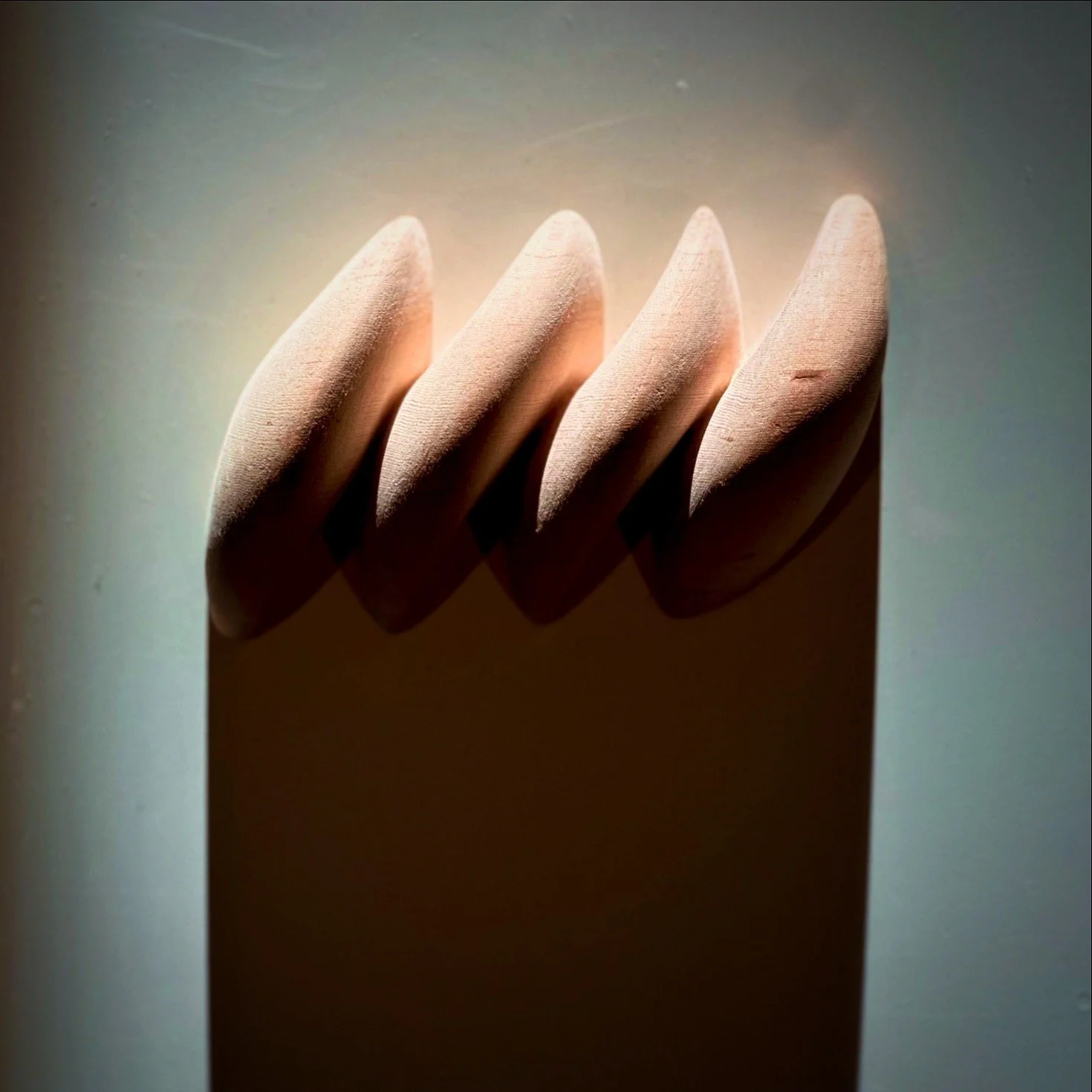
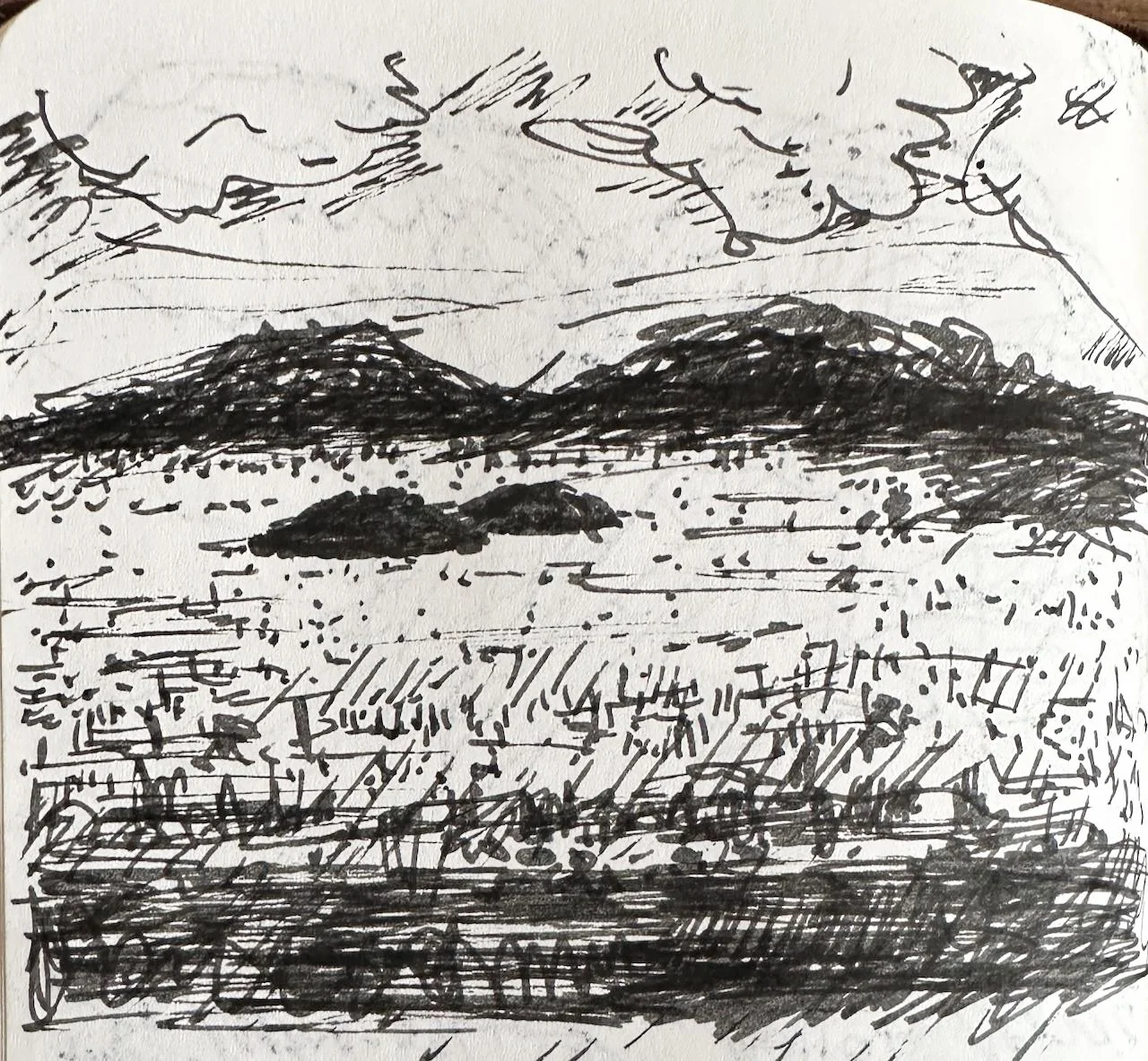
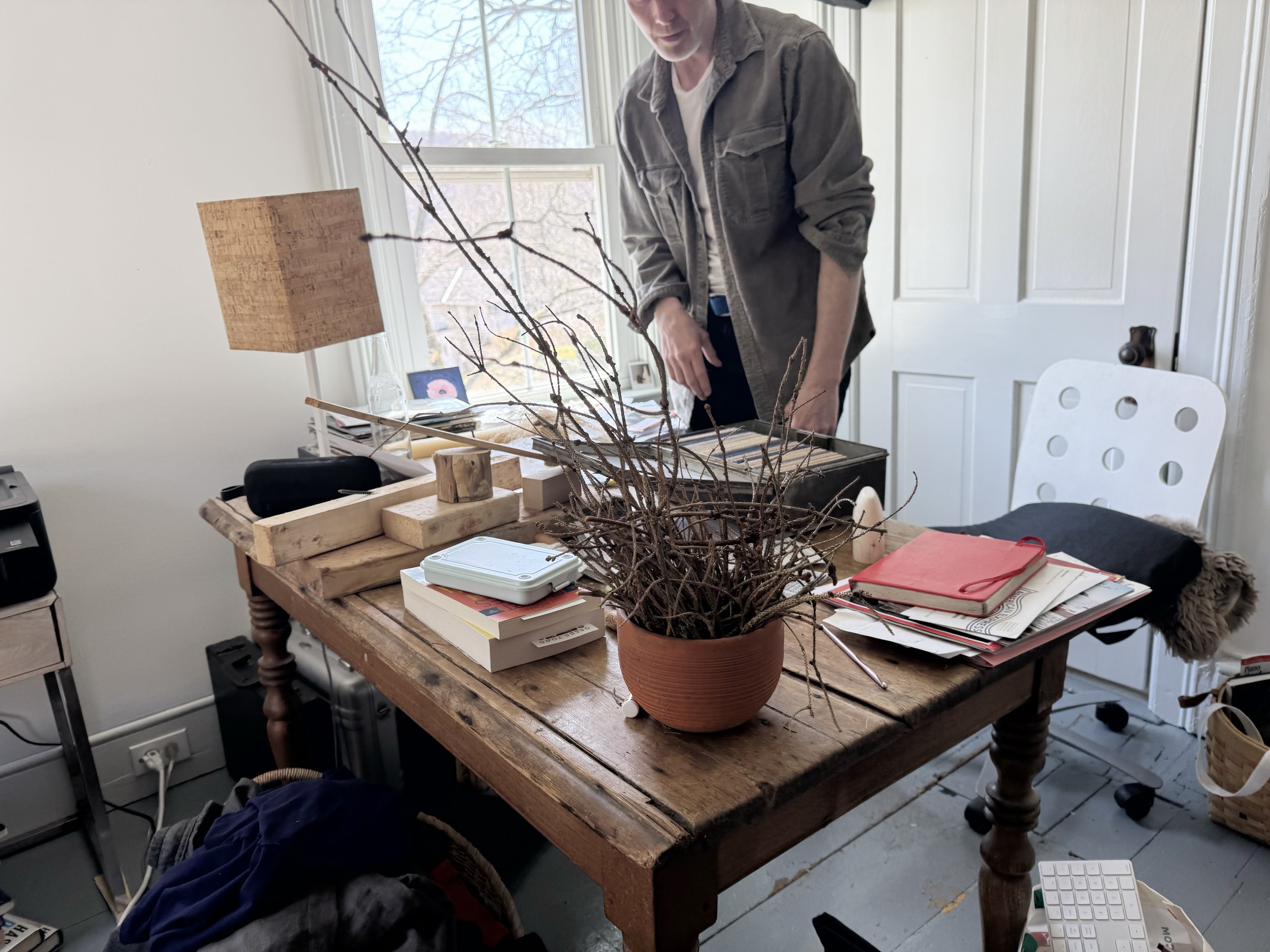
All of my work takes form in sketches, usually in small notebooks and then with experimentation in my studio.
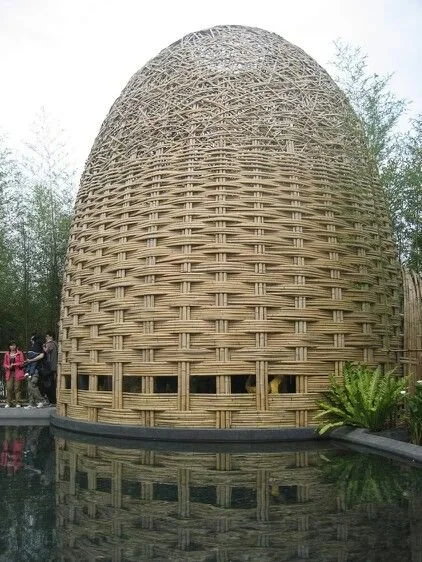
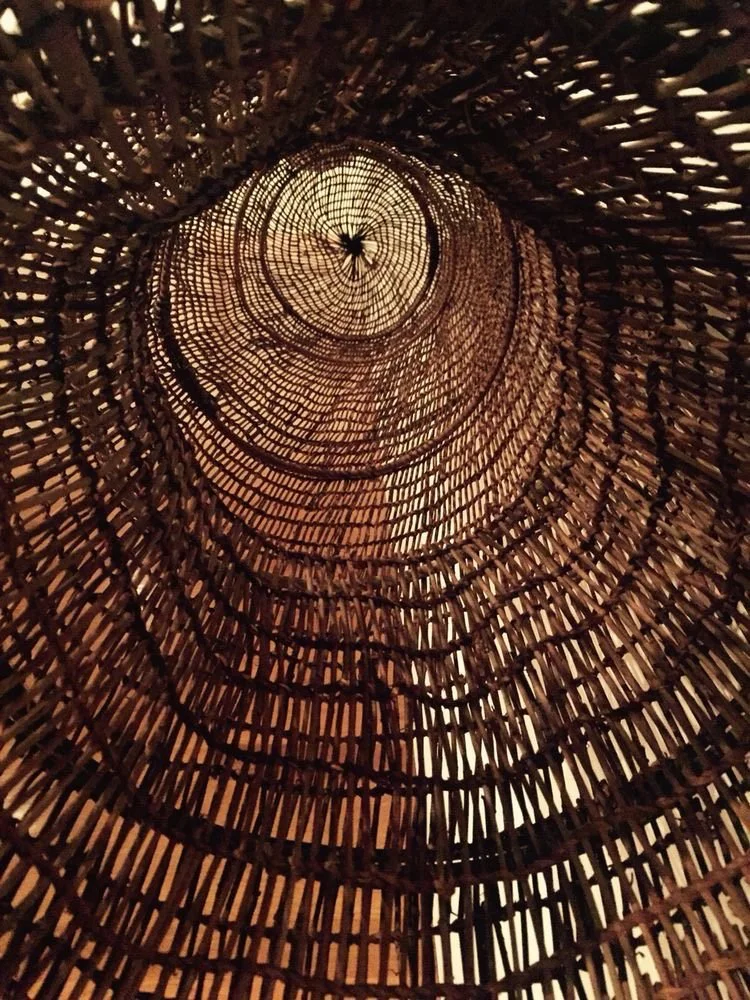
Buildings and Baskets
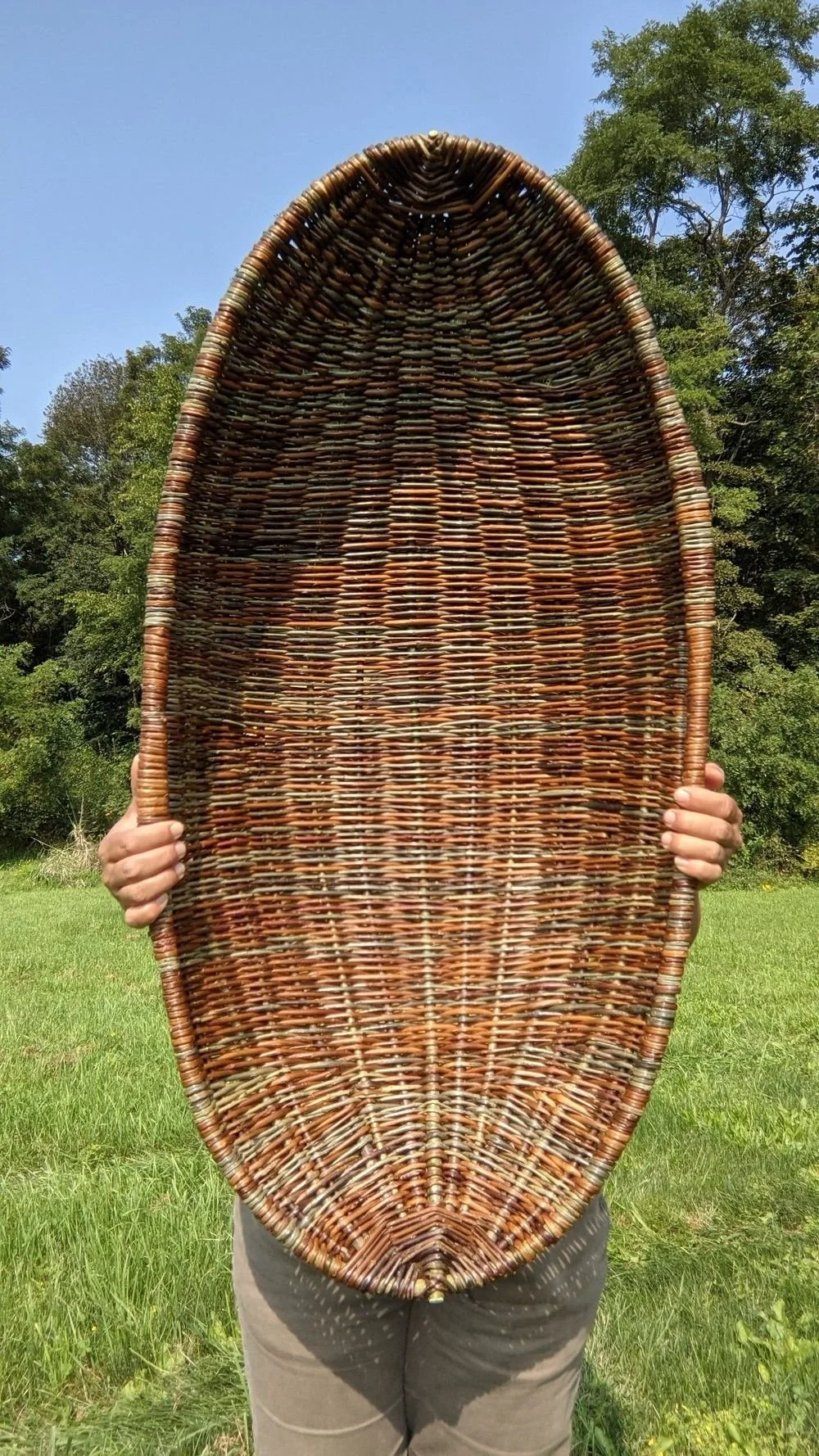
Many indigenous cultures construct lightweight buildings from strips of wood or fiber lashed woven with basketmaking techniques or lashed together. Native American sweat lodges are made with a similar frame structure as Field Mountains. . African
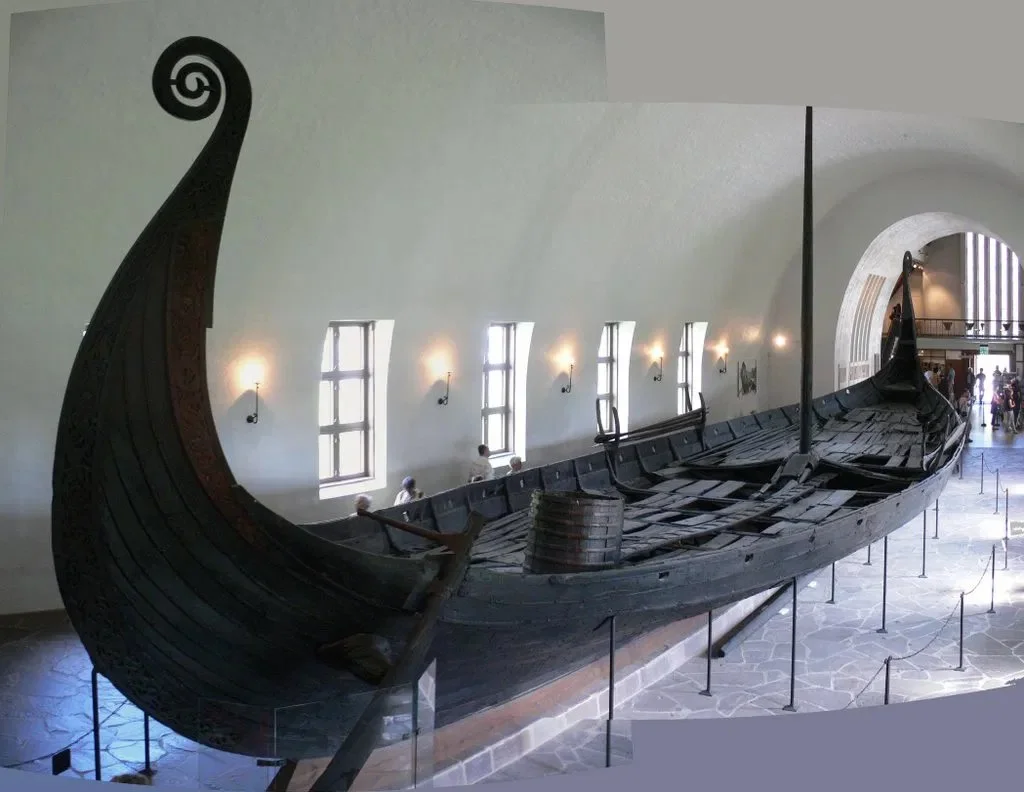
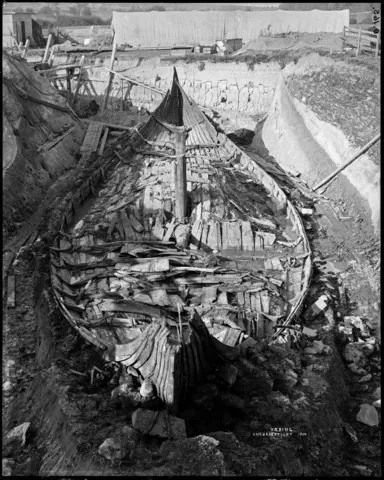
Viking Longship Burial Sites
When I laid out the footprint of the forms I realized how much they looked like the lines of a boat or ship, an allusion that is close to my soul. Being just a trace on the ground, I then thought it was like an archeological site, like a burial ship. Multiple cultures have had rituals of burying important people in their own ship with the supplies and tools they would need for travel to an afterlife. Vikings buried massive longship. The allusion to a ship burial added a sense of gravity to the placement of the forms because every detail is important and considered in such a ritual, including the angle to the sun and stars, the orientation toward settlements and I would assume Valhalla. I only considered the orientation of the surrounding mountain ranges, behind field and on the other side of the river, because the most spiritual aspect to me was always how my little mountains would relate and converse with their giant neighbors.
But as I erected the structure, an old friend died suddenly and tragically. She was an incredibly special and vibrant person and I could not stop thinking about her death and about the burial ship nature of this piece. I decided to dedicate Field Mountains to her, to honor and hopefully help bring her safe passage to wherever it is she is headed.
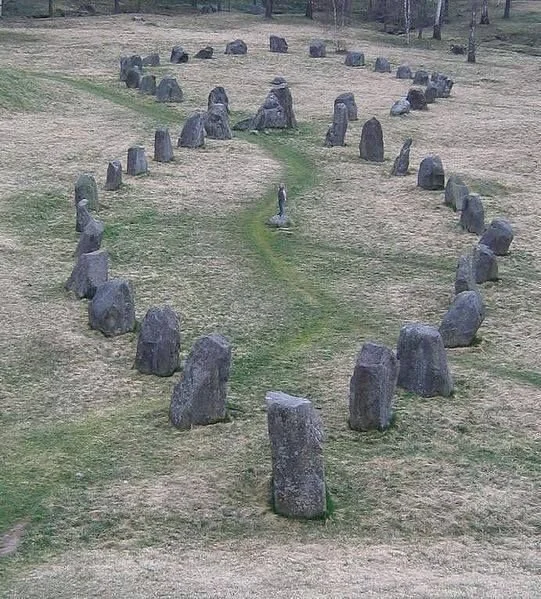
There are many other meanings and references in my mind that I will not list here (except that I also think of them as giant footprints), because meanings are infinite as are the meanings viewers will find for themselves.
Process
Willow
At approximately sixty feet long, and needing to be biodegradable, Field Mountains required a different set of materials than my original carved wood sculptures which are under a foot long. I have worked with weaving, knotting, and basket-making techniques with materials like grass, fiber cord, and other natural materials so was excited to further that experimentation on a sculpture of this size. I chose to work with willow shoots, a material that is used to make baskets. The Turquoise barn has willow on its property and I could get more from other sources. However, when I plotted out the foot print of the sculpture in the early Spring of 2025, I decided the sculpture needed to be much larger than thirty feet, what I had proposed, and closer to sixty feet. This required an adjustment to the materials.
Split Ash
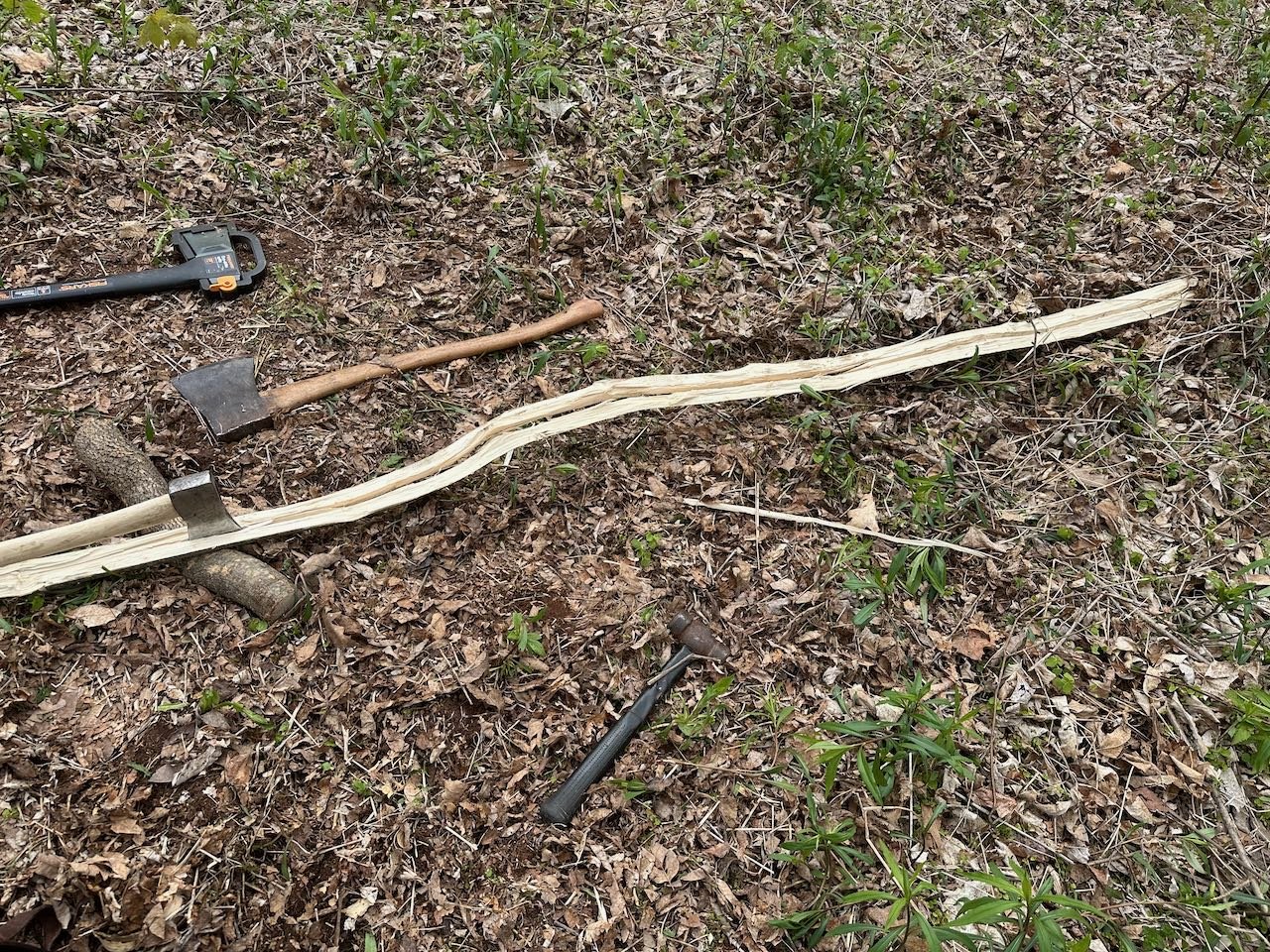
Willow is not long enough to bend across a form that is ten or twelve feet wide and eight feet tall so I decided to split ash trees on my friend Trevor’s property lengthwise into bendable sections. This was hard work that added a month or two to my schedule. I found I could not pound an axe head down the length of a trunk because it would follow the grain and swerve to the side. I had to drive axe heads in one at a time perpendicular to the trunk, alternating, the whole way. Once I split a thirty foot piece of tree in half, I split each half lengthwise as well. If the tree was large enough I split these halves again. Once I had developed a technique, I yielded about 6 or eight pieces from each tree I processed. I stored the pieces in Trevor’s pond to keep them moist and limber then Trevor helped me transport them all to the site in his truck.
The Sequence of Work
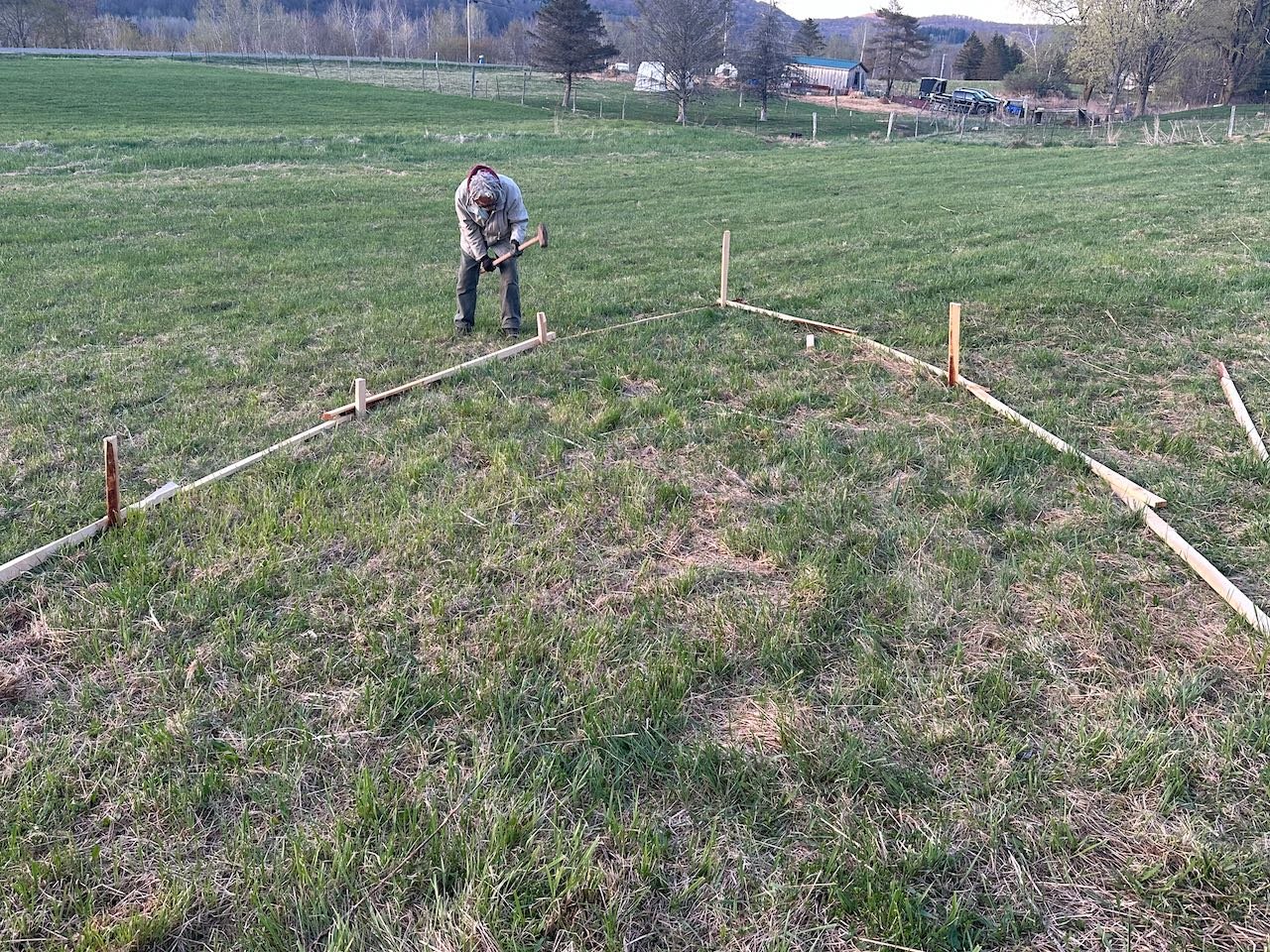
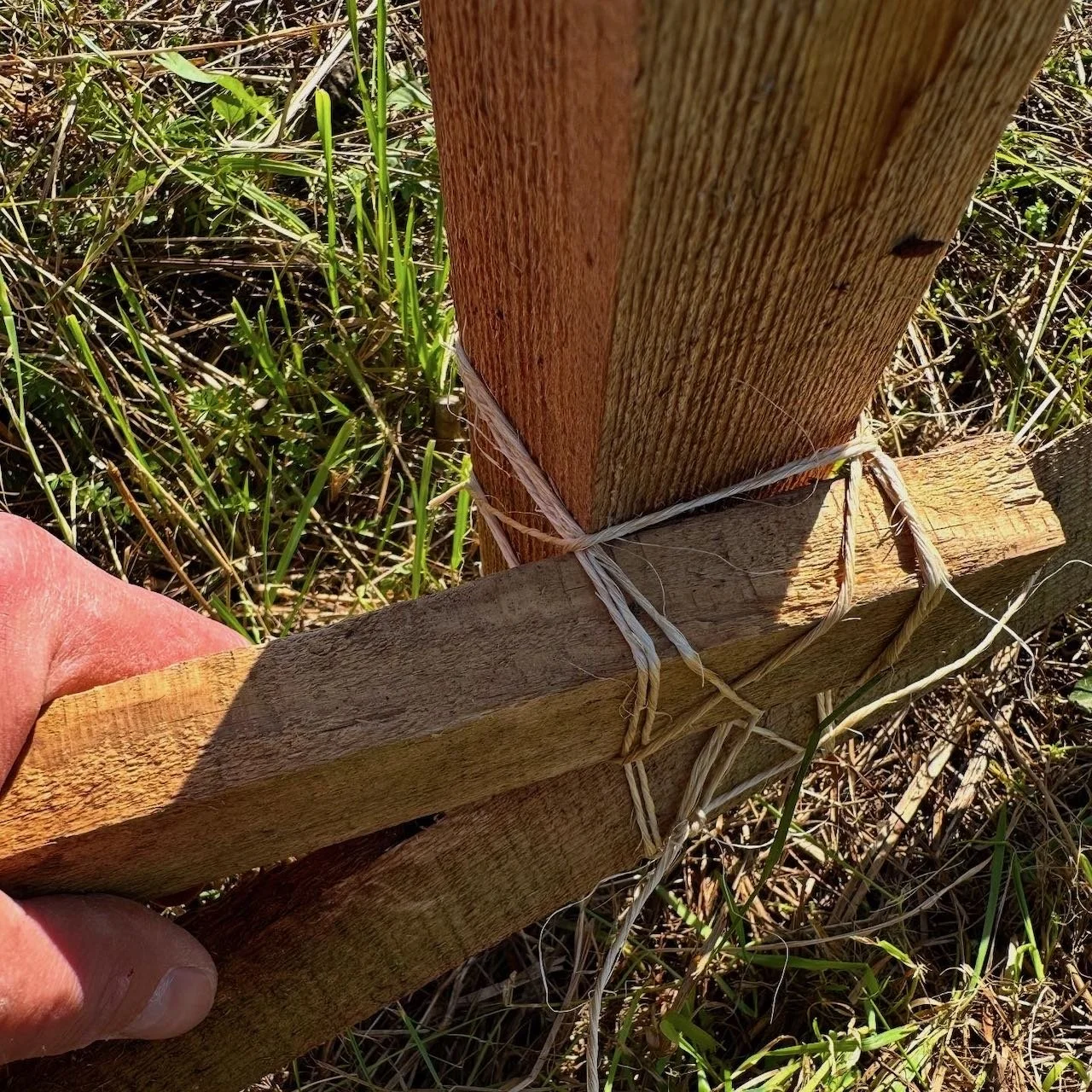
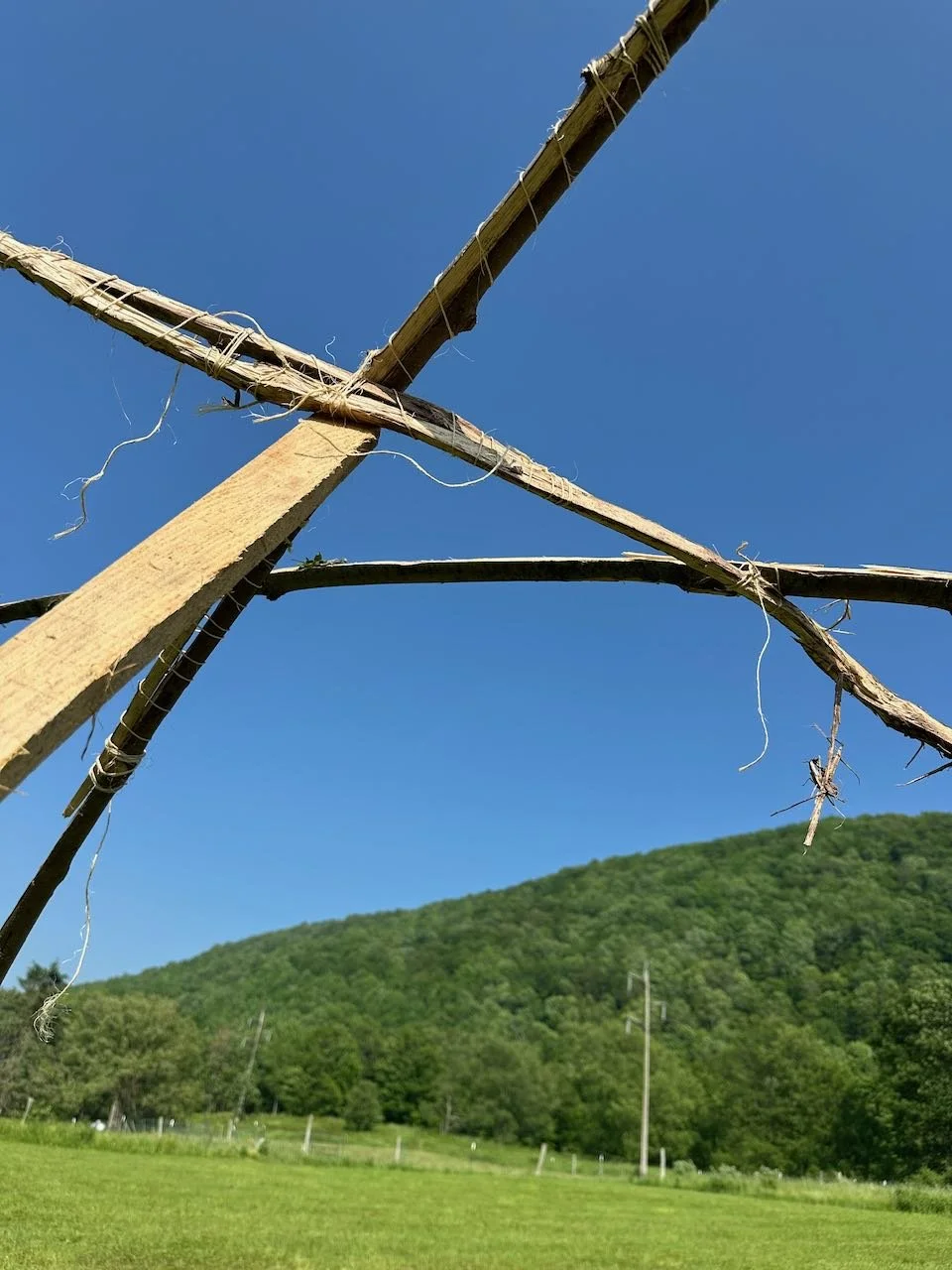
The structure of Field Mountains begins with a frame foundation made from lightweight, scrap timber, the rough edges of logs that are discarded when cutting boards, acquired from a nearby lumber mill. This stock was used to make stakes that are driven into the ground and horizontal frame pieces that are lashed to the stakes with sisal cord.
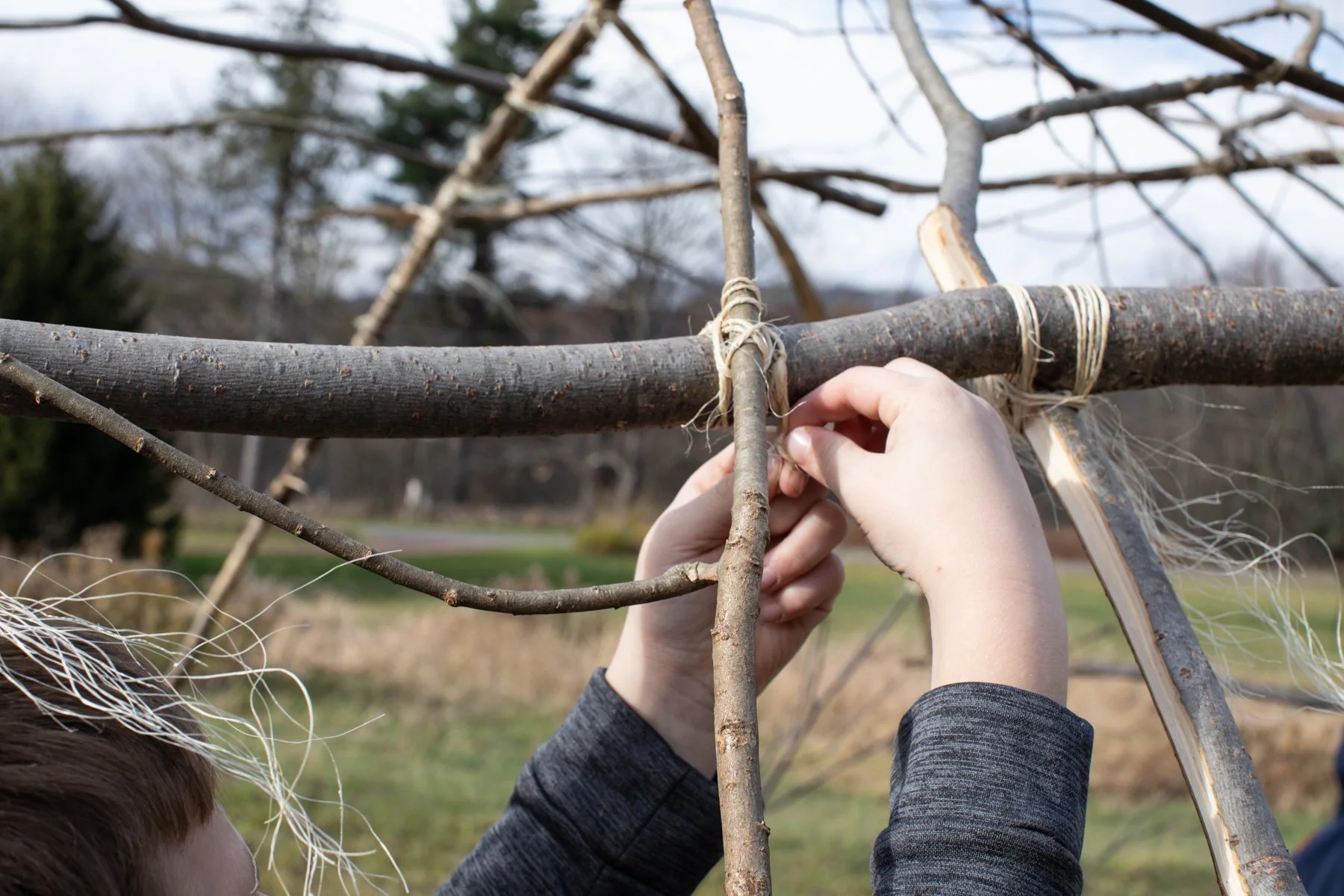
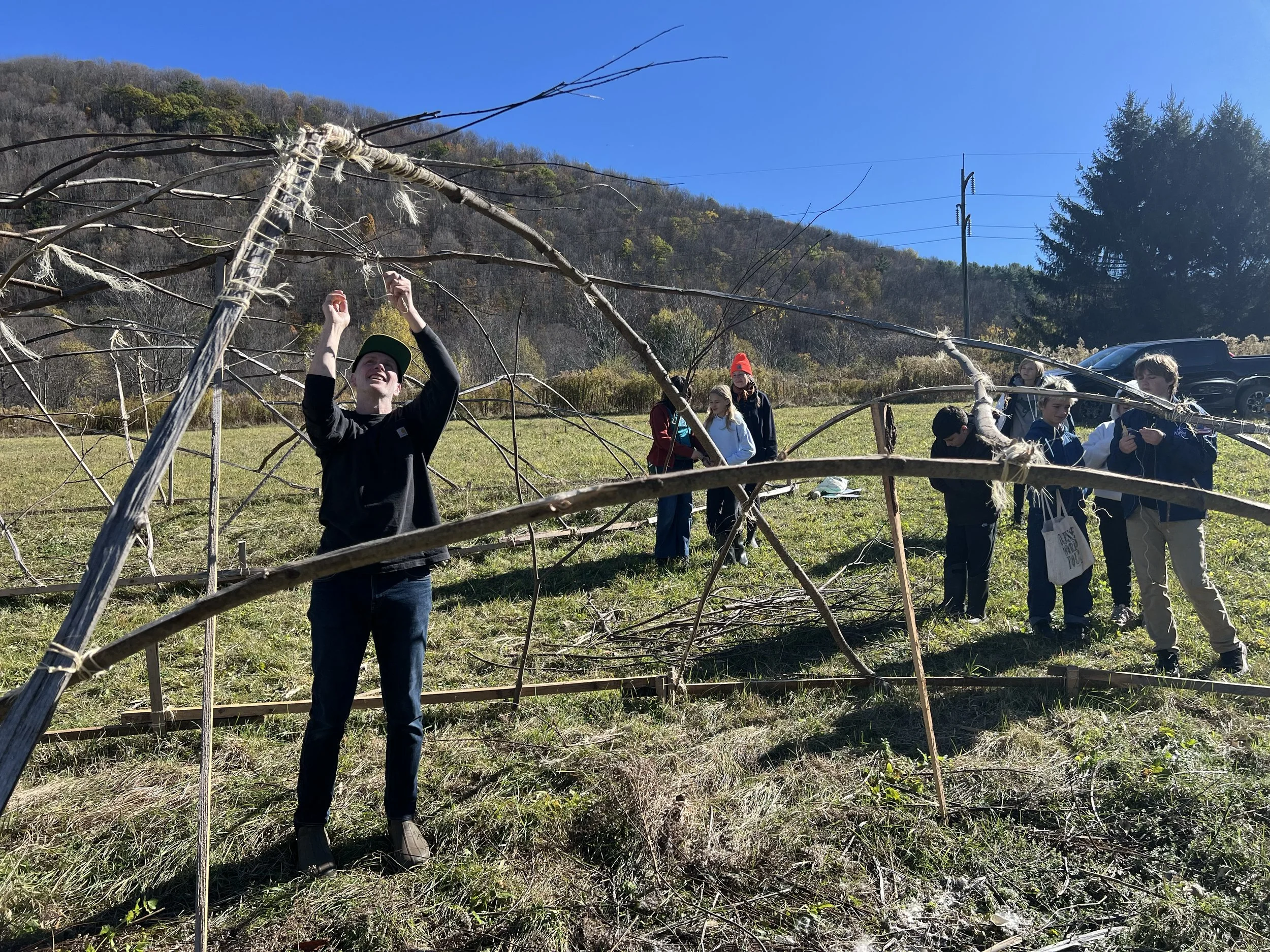
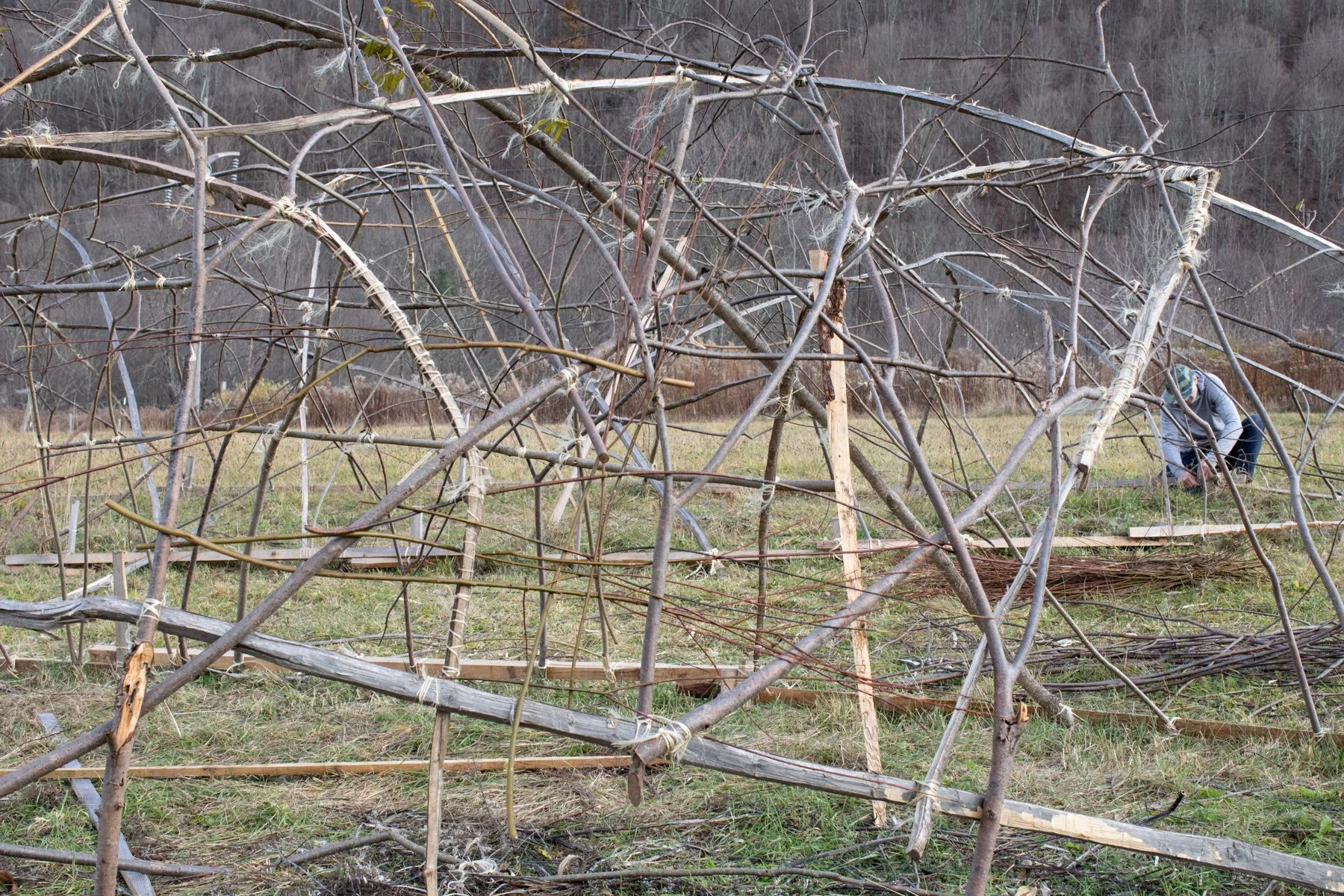
Next, split ash—quarters, sixths, or eighths of small trunks—was bent in freeform hoops from one frame edge to the other and lashed the the frames and to one another. A lightweight, skeleton structure was created with these pieces of ash. Lashing the pieces wherever they cross gives the structure tensile strength.
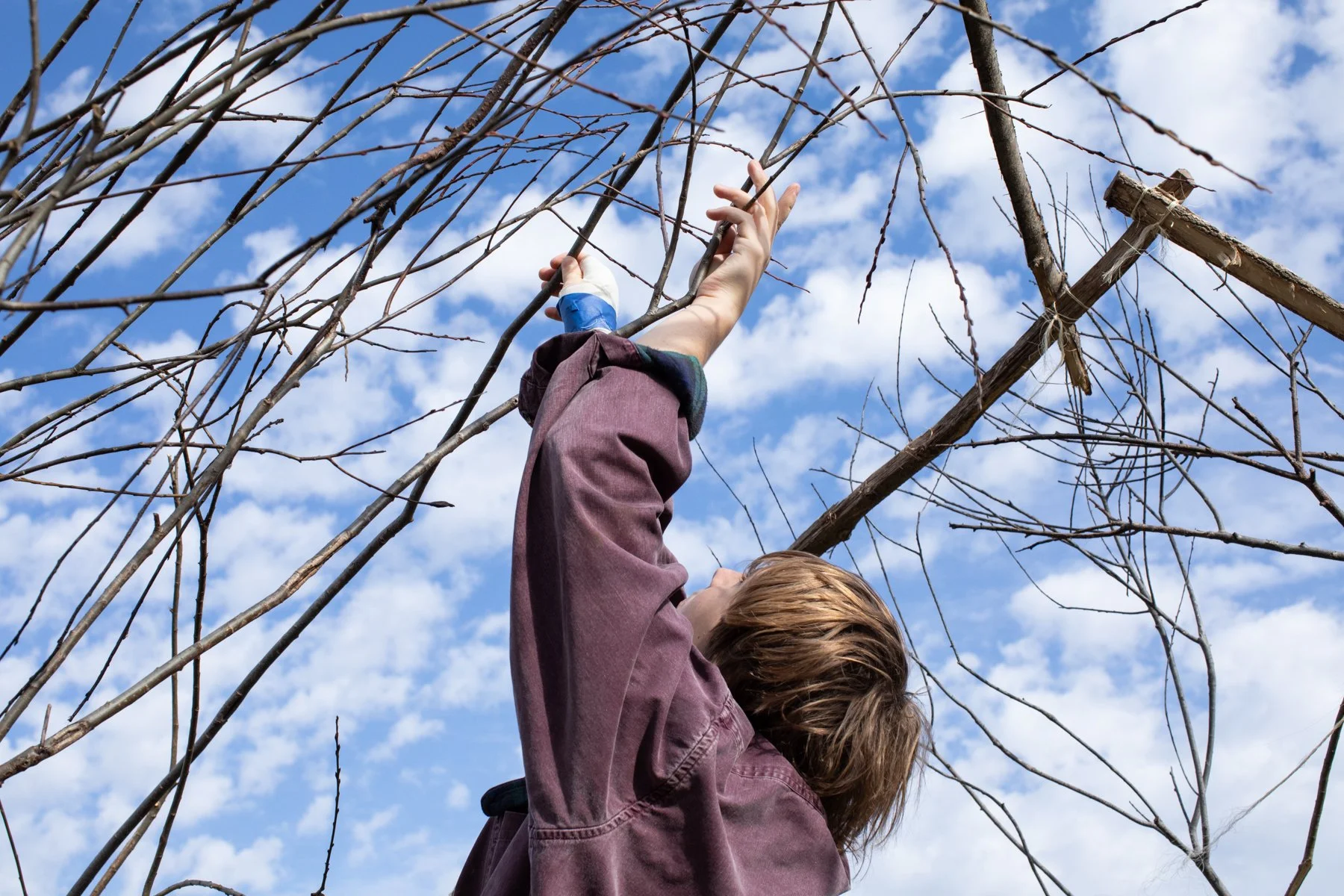
Next, longer, thicker willow shoots and branches are incorporated to fill out the structure and narrow the gaps in the structure. These too are lashed to the frames and to each other frame piece they cross.
Lastly, the openings will be filled with willow shoots, or rods. This is the stage I am at as of completion and I am testing methods for this work. I had intended to weave these thinner pieces together directly into the structure, but I am considering making a template for each of the openings, which are all different shapes and sizes, cataloging them with keyed numbers, and then weave willow together in panels to match these shapes. Finally I would lash them onto the structure individually in their assigned places.
The project required me to refine a selection of techniques. I had to find materials that work well well together. I settled on a few types of knots and lashing that work best with the sisal twine, are most quick to tie, and are strong and tight. I had to adapt to the ash pieces, which are up to thirty feet long, breaking then they were bent, by attempting to repair them with splints and lashing. I also found I had to use a hatchet to remove material from these piece to make them more flexible.
COMMUNITY ENGAGEMENT
As with most art, a main intention with Field Mountains is for it to be seen by as many people as possible
and to, ideally, encourage thoughts about the work and, in this case, the Delaware County landscape in general. A public work, it will be seen by dozens, if not hundreds, of people every day as they travel Rt. 18. I am grateful for this opportunity and feel a responsibility to create a work that respects the landscape and deals with topics that may enhance the viewer’s appreciation of their landscape.

I would love for viewers to think about what these shapes are, possibly see them as body forms, and by extension begin to see all the mountains differently.
My intention is also to have the project provide an educational opportunity for students in the local schools.
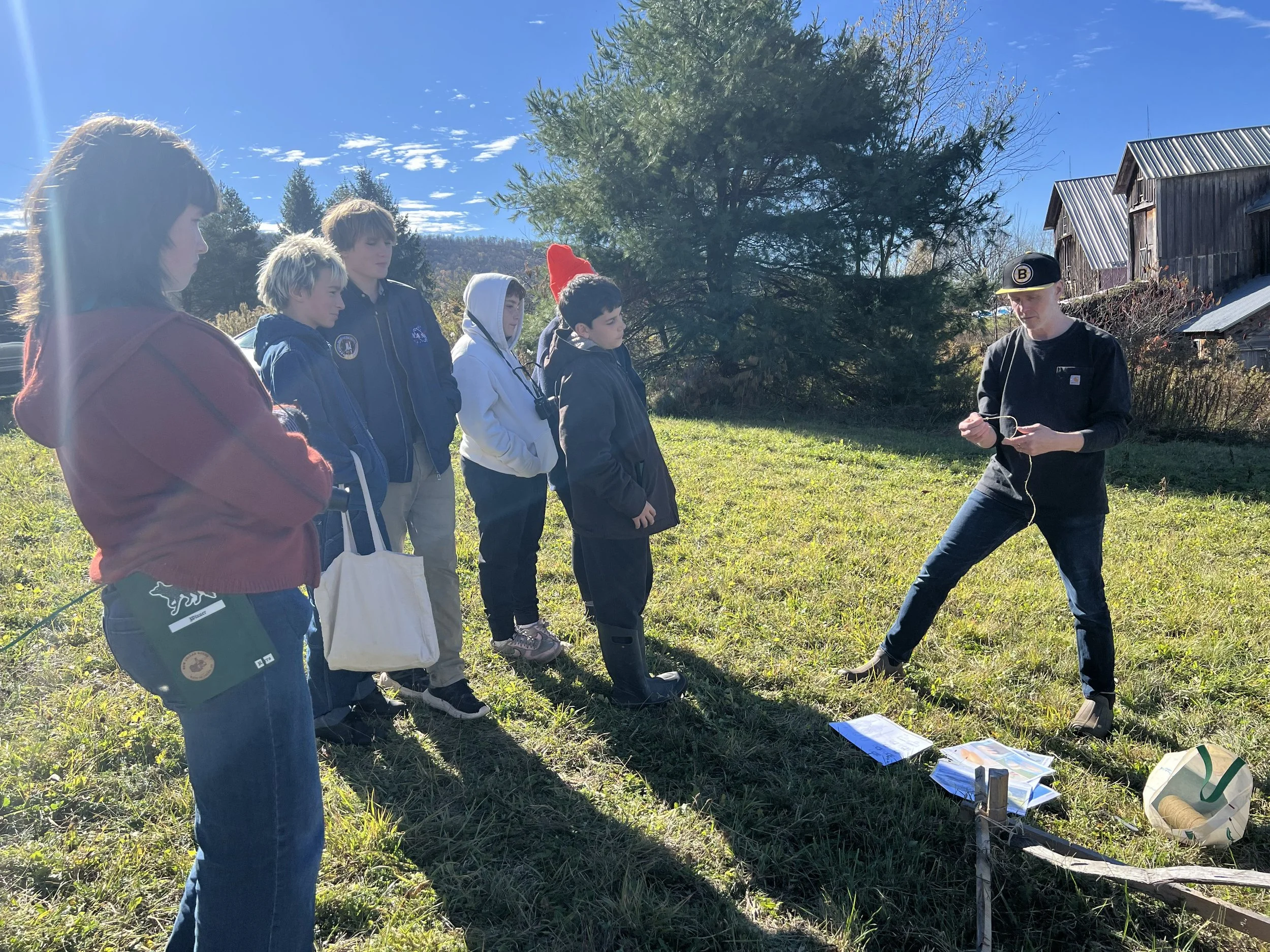
The Bovina Montessori school has incorporated the project into their curriculum in Fall 2025. I have conducted lessons onsite to teach about the origins of the idea, the techniques being used, cultural references, and the nature of making art in general. Various groups of students will return regularly to help me build the sculpture. They will document and reflect on their work.
I reached out to local art teachers in the local schools, but please use the form below to contact me if you are a teacher who would like to bring students to see the sculpture and speak to me about the work.
About me
I am an artist and I live in Upstate New York in the Northwest Catskills. I am a graduate of the Rhode Island School of Design. I owned my own graphic design and marketing company in Manhattan for several decades. While I majored in graphic design at RISD, I studied sculpture and other mediums as well and continued to make art over the years. I have also been a game designer for about ten years. I also make jewelry that relates to my sculpture practice. I have had a house in this region of New York since 2006, but became a full-time resident in 2019.
Logistics
How can I best view the work?
The primary way people will view the work is by driving past it on Rt 18. The road is usually not busy, so pulling over the shoulder to stop should be a possible, but we leave that decision is your responsibility and your liability. You can also choose to come to the site when there is an event, either an event at the Turquoise Barn, or an event for the Field Mountains work itself. You may also reach out via the contact form above to schedule a viewing.
Can I go inside it?
Sorry, no. The forms will be sealed over with willow.
Can I climb on it?
Please, no!. The piece has enough structural integrity to support itself, but not the weight of a human. Do not push or put any weight on the sculpture.
Where is it again?
The Turquoise Barn
8052 County Route 18 (also known as Back River Road)
Bloomville, NY 13739
It is in the field just East of the Turquoise (colored) barn.
If you are there for an event, pull into the gravel driveway that is also just past the barn.